01 Jun 2026
Ipamorelin vs CJC-1295: Two Points on the GH Axis
Ipamorelin and CJC-1295 both sit within growth hormone research but act through different receptor pathways. A breakdown of the mechanisms and why they are frequently studied together.
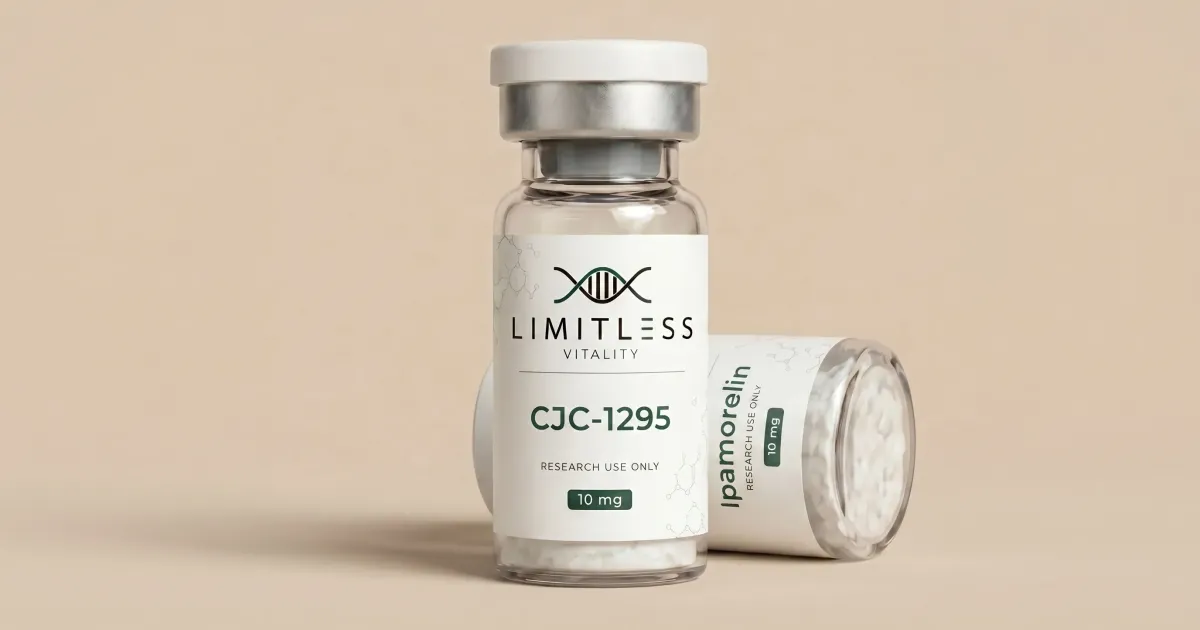
Ipamorelin and CJC-1295 are both studied in the context of growth hormone research, and they are frequently discussed together. The reason for this is mechanistic: the two compounds act at different points on the growth hormone axis, which has made their combination a subject of particular interest in the research literature. Understanding each compound individually is the starting point for understanding why.
The Growth Hormone Axis: Brief Background
Growth hormone (GH) release from the pituitary gland is regulated by two primary signals. Growth hormone-releasing hormone (GHRH), produced in the hypothalamus, stimulates the pituitary to release GH. Somatostatin, also from the hypothalamus, acts as a brake on GH release. A third pathway involves ghrelin, a peptide produced primarily in the stomach, which acts on GH secretagogue receptors (GHS-R1a) in the pituitary and hypothalamus to stimulate GH release through a mechanism distinct from GHRH.
Both ipamorelin and CJC-1295 interact with this system, but through different receptors and at different points in the signalling pathway.
Ipamorelin: GH Secretagogue
Ipamorelin is a synthetic pentapeptide consisting of five amino acids. It belongs to the growth hormone secretagogue (GHS) class and acts primarily on the GHS-R1a receptor, the same receptor targeted by ghrelin. Research has focused on ipamorelin's selectivity: it stimulates GH release with studies showing minimal effect on cortisol, prolactin, and ACTH release, which distinguishes it from earlier compounds in the GHS class that produced broader hormonal responses.
This selectivity has been a central subject of research interest. Earlier GH secretagogues such as GHRP-2 and GHRP-6 were found to elevate cortisol and prolactin alongside GH. Research published comparing ipamorelin directly with these compounds identified a significantly more selective GH release profile, making ipamorelin a subject of interest for researchers studying the GH axis without the confounding variables introduced by broader hormonal stimulation.
Ipamorelin's half-life is short, consistent with other peptides in its class, and research has examined its effects in the context of pulsatile GH release, the natural pattern by which GH is secreted in distinct pulses rather than continuously.
CJC-1295: GHRH Analogue
CJC-1295 is a synthetic analogue of growth hormone-releasing hormone (GHRH), the naturally occurring hypothalamic peptide that stimulates pituitary GH release. It is a modified version of the first 29 amino acids of GHRH, with structural changes introduced to extend its half-life and improve stability.
CJC-1295 without DAC, sometimes referred to as Mod GRF 1-29, retains a shorter half-life and produces a more acute, pulsatile GH response. A separate form with a Drug Affinity Complex (DAC) modification enables the peptide to bind to albumin in the bloodstream, extending its half-life to several days and producing a more sustained elevation in GH. The two forms are not interchangeable in research protocols and produce distinct GH release patterns.
CJC-1295 acts on GHRH receptors in the pituitary, stimulating the synthesis and secretion of GH. Research has focused on its ability to raise baseline GH and IGF-1 levels over time, with studies examining the duration and magnitude of GH elevation following administration at various doses.
Why They Are Studied Together
Ipamorelin and CJC-1295 interact with two distinct receptor systems involved in GH regulation. CJC-1295 acts on GHRH receptors; ipamorelin acts on GHS-R1a receptors. Because these pathways converge on GH release through different mechanisms, the research literature has examined whether their combination produces a synergistic effect on GH output that exceeds what either compound produces alone.
The hypothesis is grounded in the physiology of GH pulsatility. GHRH stimulation (via CJC-1295) amplifies the GH pulse, while GHS-R1a stimulation (via ipamorelin) triggers the pulse itself and simultaneously suppresses somatostatin, the inhibitory signal that would otherwise attenuate GH release. The combination therefore addresses both the amplitude of GH release and the inhibitory counter-signal in a way that single-pathway stimulation does not.
Preclinical and early clinical research examining GHRH analogues in combination with GH secretagogues has documented this synergistic effect on GH output, forming the basis for the significant research interest in this combination.
Key Differences at a Glance
Mechanism: Ipamorelin acts on GHS-R1a (ghrelin receptor pathway). CJC-1295 acts on GHRH receptors.
Classification: Ipamorelin is a GH secretagogue. CJC-1295 is a GHRH analogue.
Half-life: Ipamorelin has a short half-life consistent with pulsatile dosing. CJC-1295 without DAC (Mod GRF 1-29) also has a shorter half-life; the DAC form extends this to several days.
Selectivity: Ipamorelin is noted in the research for its selective GH release profile with minimal effect on cortisol and prolactin.
Research focus: CJC-1295 research has focused on sustained GH and IGF-1 elevation. Ipamorelin research has focused on selective pulsatile GH stimulation.
Research Status
Both compounds remain research peptides. Neither has received regulatory approval as a therapeutic agent. The research into both compounds, individually and in combination, has contributed to the broader scientific understanding of how the GH axis can be modulated through receptor-specific peptide interventions.
View the Ipamorelin and CJC-1295 product pages for compound specifications and availability.
All compounds discussed in this article are for research use only.